Healthcare
OpenEMR Implementation and Support Services: A Complete Guide for Healthcare Providers
What OpenEMR support services cover, why healthcare providers of every size need them, and how to choose the right OpenEMR support partner.
By the Ayeim Team, OpenEMR specialists with more than five years of focused OpenEMR experience
OpenEMR is a free, open-source electronic health record (EHR) and practice management system used by healthcare organizations around the world. It brings patient charting, scheduling, e-prescribing, billing and a patient portal together in one web-based application, and its standards-based APIs, including FHIR and REST, let it connect with other systems. Because it is open source, organizations can host it where they choose and shape it around how they work.
This guide explains what OpenEMR support services cover, why healthcare providers of every size need them, from independent practices to large healthcare networks, and how to choose the right OpenEMR support partner.
If you are new to OpenEMR itself, start with our guide What Is OpenEMR? A Practical Guide for Healthcare Providers and Organizations.
How OpenEMR, the open-source EHR, adds value to healthcare organizations
OpenEMR gives healthcare organizations a complete, flexible foundation for clinical and administrative work:
- No license fees. OpenEMR is free EMR software released under an open-source license, so there are no per-user or per-provider license costs.
- One system for daily work. Charting, scheduling, e-prescribing, medical billing and a patient portal live in a single application.
- Built to be shaped. With full access to the source code, forms, workflows and features can be adapted to how each organization works.
- Ready to connect. Standards-based APIs, including FHIR R4 and REST, let OpenEMR exchange data with other systems.
- Certified. Recent OpenEMR releases are ONC certified, which US organizations need for federal programs such as Promoting Interoperability.
- Your data, your choice of hosting. Organizations decide where OpenEMR runs and keep control of their own data.
- A global community. OpenEMR is developed and maintained by an active open-source community, with regular releases.
How Ayeim adds value to your organization through OpenEMR
Ayeim Technologies is a healthcare IT company with OpenEMR at the center of its work. For more than five years, our team has helped healthcare organizations turn OpenEMR’s flexibility into a system that fits the way they work.
- One partner for the whole journey. From implementation and secure data migration to integrations, customization, compliance and long-term support.
- Built around your workflows. OpenEMR is shaped to how your organization operates, not the other way around.
- For organizations of every size. From independent practices to large, multi-site healthcare networks.
- Confidential by default. We keep every client’s details private, because their privacy and their patients’ privacy come first.
OpenEMR features and their advantages
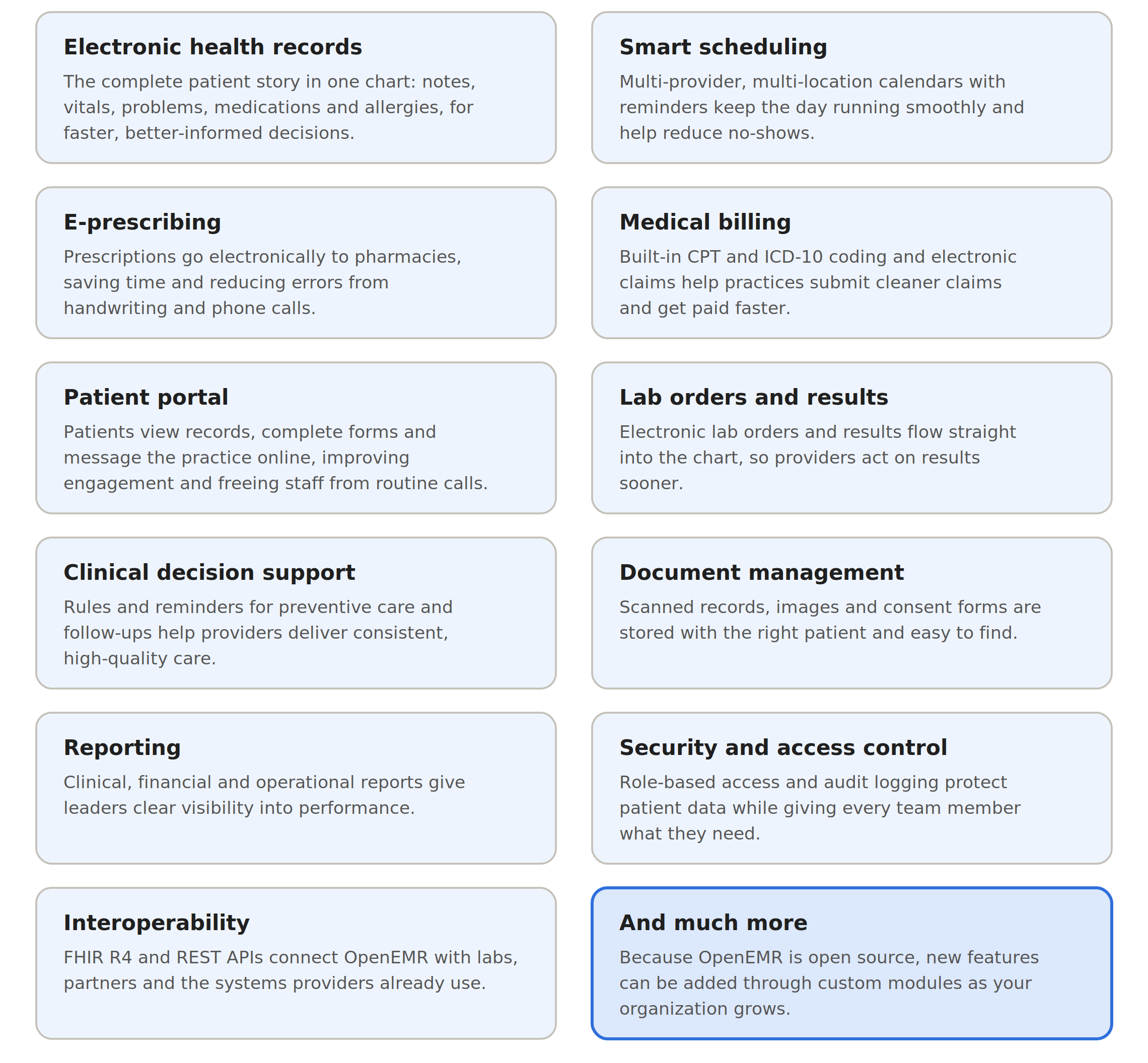
OpenEMR covers the clinical, administrative and financial work of a healthcare organization in one system. Its features include electronic health records, smart scheduling, e-prescribing, medical billing, a patient portal, lab orders and results, clinical decision support, document management, reporting, security and access control, and interoperability. Here is how each one adds value to healthcare providers.
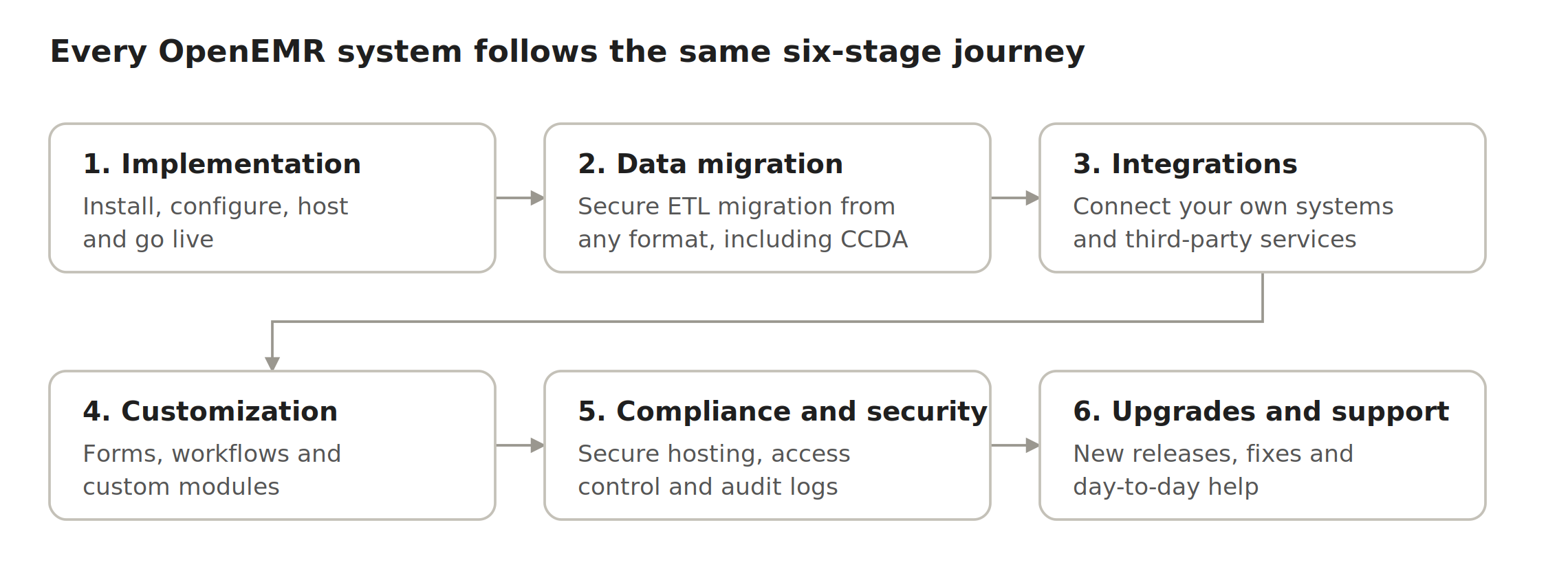
The OpenEMR journey: from implementation to long-term support
Every OpenEMR system goes through the same journey. It starts with implementation and data migration, grows through integrations and customization, is protected by compliance and security work, and then lives on through upgrades and support.
1. Implementation: getting OpenEMR live
The journey starts with implementation. OpenEMR is installed and configured for the organization’s users, roles and workflows, set up on secure hosting, loaded with any data moving over from older systems, and taken live with the people who will use it. OpenEMR can be installed on an organization’s own servers, with Docker, or in cloud environments such as AWS. Decisions made here shape every stage that follows.
2. Data migration: moving your records safely
Moving existing records into OpenEMR is often the step organizations worry about most. Ayeim uses proven ETL (extract, transform, load) tools to migrate data from any source format, from CCDA documents to spreadsheets and databases from other EHR systems, and maps every record accurately into OpenEMR. Each migration follows a security-first process, planned and protected end to end, so patient data stays safe and day-to-day operations continue without disruption.
For a closer look at how this works, read our guide to OpenEMR data migration planning and validation.
3. Integrations: connecting OpenEMR to everything else
Once OpenEMR is live, it rarely works alone. It provides standards-based interfaces, including the OpenEMR FHIR API (FHIR R4), a REST API and HL7 integration, for exchanging data with the organization’s own systems. Third-party integrations connect it to outside services and partner platforms, each with its own formats and rules. Building these connections is half the job; keeping them reliable as both sides change is the other half.
4. Customization: shaping OpenEMR around the organization
With data flowing, the next need is fit. Out of the box, OpenEMR is built around a typical provider workflow, and complex organizations rarely work that way. Customization adapts forms, screens and workflows, and custom modules add capabilities OpenEMR does not include. Because this code lives alongside the core system, it has to be maintained with every future update.
5. Compliance and security: protecting health data
Health data brings legal and security obligations, such as HIPAA in the US. Recent OpenEMR releases are ONC certified, and OpenEMR provides building blocks like role-based access control and audit logging, but compliance depends on how the system is hosted, configured and run: hardened servers, encrypted connections and backups, the right access for each role, and the processes around them.
6. Upgrades and ongoing support: keeping it running
The journey does not end at compliance. New OpenEMR releases and security fixes have to be applied without breaking the integrations and customizations built on top. And when something stops working, users need a team that already knows their system, not one learning it from scratch.
A partner who works across the whole journey sees how each stage affects the next, so a customization never breaks an integration and an upgrade never undoes security work.
Why every healthcare organization needs ongoing OpenEMR support
OpenEMR delivers value from day one, and the right support keeps that value growing as your organization changes.
OpenEMR is open source, so there is no vendor responsible for your particular setup. Once an organization adds its own forms and modules, connects other systems, and handles sensitive health data every day, three things become true:
- Changes never stop. Business rules, partner systems and reporting needs keep evolving, and the software has to keep up.
- Every connection is a dependency. When OpenEMR exchanges data with other systems, a change on either side can break the link.
- Updates carry risk. New OpenEMR releases and security fixes have to be applied without breaking the customizations the organization relies on.
That is why healthcare providers of every size, from independent practices to large networks, need a partner who knows both OpenEMR and their specific system, and who stays with them over time.
Signs your OpenEMR system needs a support partner
Many organizations only look for help once something breaks. These signs usually appear first:
- Upgrades keep getting postponed because nobody is sure what they will break.
- An integration fails and it takes days to find out why.
- Custom code was written by someone who is no longer around.
- Nobody has reviewed the hosting and security setup in a long time.
- Users work around OpenEMR instead of with it.
If two or more of these sound familiar, your system needs ongoing support, not another one-off fix.
In-house team or specialist OpenEMR partner?
Once you know you need support, the next question is who provides it. Both an in-house team and a specialist partner can work. The right choice depends on how much OpenEMR depth you can build and keep inside your organization.
| In-house team | Specialist OpenEMR partner | |
|---|---|---|
| OpenEMR know-how | Has to be built and retained internally | Brings experience from OpenEMR work already done |
| Coverage | Depends on a few people; gaps appear during leave or turnover | A team covers every stage, from implementation to support |
| Cost model | Salaries and training, whether or not there is work | Pay for the scope you need |
| Upgrades with customizations in place | Often learned for the first time, on your live system | Planned from experience |
| Best when | You have a large, stable IT team dedicated to OpenEMR | You need depth across all six stages without building a team |
How to choose an OpenEMR support partner
Whether or not you work with us, these questions will tell you a lot about any OpenEMR partner:
- How long have you worked with OpenEMR specifically? General web development experience is not the same as knowing OpenEMR’s code, modules and upgrade path.
- Do you currently support an OpenEMR system long-term? A partner that only builds and hands over has not lived with the consequences of its own work.
- Can you cover all six stages? Implementation, data migration, integrations, customization, compliance and security, and upgrades and support are linked. Splitting them across vendors creates gaps.
- How do you protect client confidentiality? A partner who freely names clients and shares their details may treat your data the same way.
- How do you handle OpenEMR upgrades with customizations in place? The answer shows whether they plan for the long term.
Who Ayeim works with
We work with healthcare organizations of every size and type, and specialize in medium to complex OpenEMR projects.
A project is usually medium to complex when it involves one or more of these:
- Custom modules or significant changes to OpenEMR’s standard workflows
- Data exchange with internal systems or outside partners
- Sensitive data that demands careful hosting and security
- A system that has to keep running and evolving for years, not just go live once
Frequently asked questions
What do OpenEMR support services include?
Long-term OpenEMR support typically covers customization and custom modules, integrations and APIs, third-party integrations, hosting, security and upgrades, and ongoing support and bug fixes.
How does OpenEMR handle FHIR R4 APIs?
OpenEMR includes a FHIR R4 API alongside its REST API, so it can exchange data with other systems in a standards-based way. Each integration still needs to be designed, secured and tested for the systems it connects.
Is OpenEMR secure and HIPAA compliant?
OpenEMR includes security features such as role-based access control and audit logging. Whether a deployment is HIPAA compliant depends on how it is hosted, configured and managed, which is why secure hosting and ongoing maintenance matter.
What is the difference between OpenEMR and proprietary EHRs?
Proprietary EHRs are licensed from a vendor that controls the code, pricing and roadmap. OpenEMR is open source: there are no license fees, the code can be customized, and you choose where it is hosted.
Is OpenEMR a good open-source EMR for small clinics?
Yes. With no license fees and a complete set of clinical and billing features, OpenEMR is a practical choice for small and independent clinics.
Can OpenEMR be customized for a specialty practice?
Yes. Forms, templates and workflows can be adapted for specialty practices, and custom modules can add features a specialty needs.
Can OpenEMR be hosted in the cloud?
Yes. OpenEMR is web-based and can run on cloud infrastructure or on an organization’s own servers. Ayeim provides secure OpenEMR hosting, security and upgrade services.
Is OpenEMR only for clinics?
No. OpenEMR is widely used by provider practices, but organizations beyond the clinic use it too.
Can Ayeim work on an existing OpenEMR application?
Yes. We work on existing OpenEMR applications as well as new projects. That includes live systems that are already customized and connected to other software.
Does Ayeim offer a free OpenEMR system review?
Yes. Share a few details about your OpenEMR setup and goals, and the Ayeim team will review them for free.
What to prepare before talking to an OpenEMR partner
Having these answers ready makes any first conversation faster and more useful:
- Your OpenEMR version and where it is hosted
- The systems and third-party services it connects to
- Any custom modules or major customizations
- The compliance rules you must meet, such as HIPAA
- What you want to achieve next, and by when
Get a free OpenEMR system review
Whether you are planning a new OpenEMR implementation or need help with an existing application, start with a free OpenEMR system review. Share the details from the checklist above, and the Ayeim team will review your setup and goals.
Request your free OpenEMR system review today. Start a conversation
Keep reading
Related articles
OpenEMR Development: What Can Be Customized?
The extension points that keep OpenEMR maintainable, and the changes that create a fork.
Read article HealthcareHow to Modernize an Existing OpenEMR Deployment
Getting a heavily-modified or ageing OpenEMR back onto a supported, extensible footing.
Read article HealthcareOpenEMR Data Migration: Planning and Validation
A migration method that treats validation and reconciliation as first-class work.
Read articleInsights, monthly
Practical writing on AI, healthcare interoperability, integration and enterprise engineering. No noise.
We use your email only to send Insights. Unsubscribe anytime.
Next step
Working on something related?
Ayeim engineers platforms, integrations and AI across healthcare, enterprise, education, retail and professional services.